
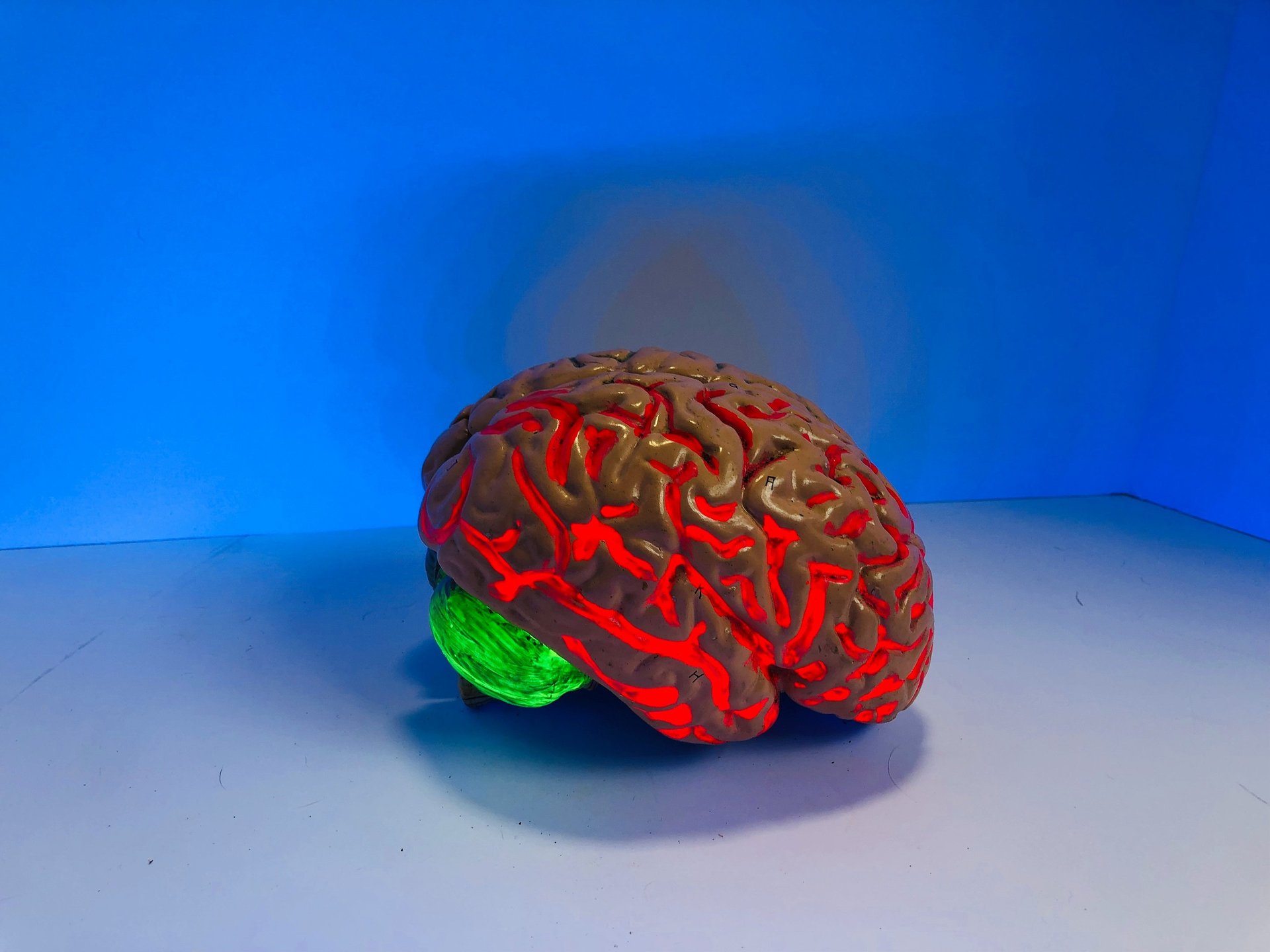
The ADHD Brain Engine
Across the Ride to Rise framework we often talk about “the engine in our helmets.”
Every brain operates across a rev range of activation.
Too little activation and the system struggles to engage.
Too much activation and the system overheats.
But some brains operate a little differently from the start.
The most important difference between a typical brain and an ADHD brain is surprisingly simple.
The baseline levels of two key brain chemicals are lower.
Those chemicals are the neurotransmitters:
Dopamine
Norepinephrine
These neurotransmitters regulate attention, motivation, focus, and action.
When these neurotransmitters are dysregulated, most typically either too low or sometimes to high; essentially a dysregulated balance in signaling , the brain engine behaves differently across the entire rev range.
This single difference creates three major challenges that many people with ADHD experience:
1. Poor Cortical Inhibition - The Noisy Classroom
The prefrontal cortex is the part of the brain responsible for executive function.
This is where we:
• Prioritize tasks
• Make decisions
• Plan actions
• Control attention
For the brain to function efficiently, the prefrontal cortex must filter an enormous amount of incoming information.
This filtering process is called cortical inhibition.
You can imagine it like a classroom.
In a well-regulated brain, the teacher stands confidently at the front of the room. The students sit quietly at their desks, raising their hands when they have something to say.
Each student represents a thought.
The teacher decides which student receives attention.
The classroom is organized.
But when dopamine and norepinephrine levels are dysregulated, that classroom looks very different.
The teacher becomes a weak substitute teacher hiding in the corner.
Meanwhile the classroom explodes into chaos.
Students are shouting.
Some are fighting.
Others are dancing on desks.
Paper airplanes are flying across the room.
Every student is trying to speak at once.
This is what poor cortical inhibition feels like.
The brain becomes noisy.
Thoughts compete for attention.
Focus becomes extremely difficult.
When dopamine and norepinephrine levels are regulated to healthy levels, something remarkable happens.
The classroom becomes quiet again.
The teacher — your executive function — stands at the front.
The students sit down and wait for instruction.
Thoughts become organized and manageable.
2. The Effort Gate
The second major challenge involves what we I call the Effort Gate.
Inside the brain is a structure called the basal ganglia. One of its important roles is determining whether the brain commits energy and resources to begin a task.
You can think of the basal ganglia as a gate that controls access to action.
When the prefrontal cortex decides something is important, the signal travels to this gate.
The brain then evaluates a simple question:
Is the effort required worth the reward?
In a typical brain, dopamine is available at regulated baseline levels.
This allows the Effort Gate to open easily when something is important.
Once the gate opens, several systems are disinhibited and receive more resources:
• Motor systems that allow action
• Focus systems that support sustained attention
• Norepinephrine systems that increase alertness and cognitive endurance
The task begins.
And the brain stays engaged until it is complete.
But in an ADHD brain, baseline dopamine levels are dysregulated and most typically lower.
So when a task arrives at the Effort Gate, there may not be enough dopamine available to open it.
Even if the person wants to do the task.
Even if they know it is important.
The gate simply stays closed.
Without that gate opening, the brain cannot release the resources needed to begin the task.
This is why many people with ADHD describe a confusing experience:
I want to do something.
I know I should do it.
But I cannot seem to start.
I have shared a personal example before where I could be sitting at the table with my mind racing about ten important things I needed to do.
Some were things I truly wanted to accomplish.
Others were tasks I knew I needed to finish but didn’t enjoy.
Yet I couldn’t seem to pick one and begin.
I would sit there stuck, confused about why I was stuck.
Why was something so seemingly simple so hard?
The answer was simple.
My brain did not have enough baseline dopamine available to open the Effort Gate.
Without that signal, my brain simply didn’t release the resources required for action and sustained attention.
Why Urgency Suddenly Works
When the Effort Gate remains closed, the brain often compensates by activating a different system.
The limbic system.
This is the brain’s fight-or-flight response.
Situations that trigger the limbic system include:
• urgency
• novelty
• competition
• danger
• emotion
• deadlines
When these conditions appear, the limbic system releases a surge of dopamine and norepinephrine.
That surge forces the Effort Gate open.
Suddenly the person can act.
Focus becomes sharp.
Performance may even become extraordinary.
This is why many people with ADHD perform incredibly well under pressure.
But relying on this system comes at a cost.
The limbic system also releases cortisol and adrenaline.
The nervous system begins running hot.
Muscles remain tense.
The body braces for danger that never comes.
Living in that state long-term leads to chronic stress, physical tension, exhaustion, and burnout.
3. Task Mode vs Default Mode
The third challenge involves how the brain switches between two major networks.
The Central Executive Network (Task Mode Network)- active when we are focused on doing / completing something.
The Default Mode Network - active when the brain is at rest, reflecting, daydreaming, or generating ideas.
In a well-regulated brain, these two networks take turns - one is biased to 'primary', and the other is 'secondary'.
When the task network activates, the default network quiets way down.
But when dopamine and norepinephrine levels are dysregulated, most often too low, the brain struggles to suppress the default mode network.
Even when someone is trying to focus, the default network can suddenly intrude.
Random thoughts appear.
Attention drifts.
New ideas pull the mind away from the task.
This is why many people with ADHD describe feeling constantly distracted by their own thoughts.
Why Medication Often Helps
Modern ADHD medications work in a surprisingly straightforward way.
They increase the baseline strength and availability of dopamine and norepinephrine in the brain.
They do not force focus.
They do not artificially create motivation.
Instead, they restore the brain’s baseline activation level.
When that baseline rises, several things begin to happen naturally.
Cortical inhibition improves.
The classroom becomes quiet and organized.
The Effort Gate opens more easily and reliably.
Tasks become easier to begin.
The task network can suppress the default network more effectively.
Focus becomes stable.
The brain engine begins running clean across the entire rev range.
Understanding the ADHD Engine
When people first learn how this system works, many lifelong experiences suddenly make sense.
Why intense environments feel easier to focus in.
Why deadlines create bursts of productivity.
Why simple tasks sometimes feel impossible to start.
They are the result of how the brain’s activation system is regulated.
When people understand how their brain engine works, they can begin designing environments, routines, and strategies that work with their system rather than against it.
And that understanding can be life-changing.
What Regulation Can Change
When dopamine and norepinephrine levels are regulated to a healthy baseline, several important changes often occur.
The brain becomes quieter.
Focus becomes easier to initiate.
Tasks are easier to start.
The nervous system no longer needs to rely on urgency and stress to function.
Many people describe a profound sense of relief when their brain finally begins operating in a regulated state.
Personal Transformation
I was diagnosed later in life with ADHD, and understanding this system has been one of the most transformative experiences of my life.
Once I became regulated with a normalized baseline of dopamine and norepinephrine, several remarkable things began to happen.
The first day I took medication, my brain became quiet.
It was almost eerie at first, but it was also incredibly peaceful.
For the first time, the classroom in my mind was calm.
The students were sitting quietly.
I could choose which thoughts to engage with and which ones to ignore.
For years there had been a constant negative voice in my head.
After regulation, that voice simply disappeared.
About two weeks later it briefly returned, and that’s when I realized something remarkable.
It had been gone the entire time.
When it appeared again, I recognized it immediately and simply told it to be quiet.
And it went quiet.
Another change was physical.
As my limbic system began to stand down, my body began to relax in ways I had never experienced before.
For years my nervous system had been operating in a state of tension and readiness.
Once that stress response eased, old injuries began healing more easily and my body felt calmer and stronger.
Memories and emotions also became more accessible.
When the brain lives in fight-or-flight mode, emotional processing and memory retrieval are often suppressed.
As my nervous system regulated, those systems began opening again.
Looking back over my life with this new understanding was incredibly freeing.
Many of the confusing experiences, decisions, and patterns that once felt chaotic suddenly made sense.
Understanding how my brain works - and learning how to regulate dopamine and norepinephrine - has made my life dramatically easier.
And for that, I am deeply grateful.
Understanding the ADHD brain doesn’t just explain the past.
It opens the possibility of finally working with your brain instead of fighting against it.
And when your engine is tuned correctly, everything changes.
A strong steady idle.
A crisp, snappy throttle response across the entire rev range whenever you hit the gas.
GJ Silver — Founder, Ride to Rise Coaching
Intensity Integration Coaching for intensity-driven minds and leaders
Continue Exploring the Ride To Rise Framework - Related Articles
The Engine In Our Helmet
Why Adventure Athletes Struggle With Everyday Life
The Ride-to-Idle Transition
Why High Performers Burn Out
Why ADHD Brains Thrive on Intensity
How Motorcycle Engine Tuning and the ADHD Brain Relate
Learn How Your Brain Engine Runs
Understanding how dopamine, norepinephrine, and the Effort Gate interact can transform how you approach motivation, focus, and action.
In Ride to Rise coaching we explore how your brain engine operates and how to regulate it so the system runs clean across the entire rev range.
The ADHD brain regulates motivation and focus differently due to lower baseline dopamine and norepinephrine. Understanding how this system works can transform how people approach focus, effort, and performance.
How the ADHD Brain Engine Works | Dopamine, Norepinephrine, Motivation and Focus


Connect
Reach out to start your transformation journey.
Call
info@ridetorisecoaching.com
+1- 206.383.9429
© 2025. All rights reserved.